Section outline

    • -masukkan banner kursus disini-

    • PLEASE KEEP OUR FOREST SUSTAINABLE!

      This 9-hour micro-credential course provides participants with a comprehensive introduction to the diversity of forest stands in Malaysia, focusing on three major forest ecosystems: inland dipterocarp forests, peat swamp forests, and mangrove forests. Delivered through three modules of three hours each, the course explores the ecological characteristics, environmental functions, and management approaches associated with each forest type.

      Participants will learn how forest ecosystems vary along environmental gradients, from coastal mangrove forests and waterlogged peat swamp forests to the drier inland dipterocarp forests. The course highlights the vital roles these forests play in biodiversity conservation, carbon storage, climate regulation, coastal protection, and socio-economic development. Special emphasis is placed on the concepts of blue carbon and peatland carbon sequestration, as well as the ecological significance of inland forest ecosystems.

      In addition, participants will gain an understanding of sustainable forest management principles and practices, including conservation strategies, restoration approaches, fire prevention, hydrological management, and responsible resource utilisation. Upon completion, participants will be able to classify forest stands based on their characteristics and management requirements, and appreciate their importance in supporting environmental sustainability, economic development, and community well-being.

    • LEARNING OUTCOME (LO)

      Three learning outcomes are expected to be achieved at the end of this course:

      1. Classify major forest stand types in Malaysia. (C2)
      2. Explain the functions and importance of forest ecosystems. (C2)
      3. Describe sustainable forest management practices. (C2)

      IMPORTANT – Please read the following guidelines before starting the course

      • This course is a self-paced learning programme consisting of six topics. Each topic contains learning materials, interactive activities, and assessments (in the form of quizzes) that must be completed.
      • The instructor may monitor your progress and activities through the platform to ensure that you have completed the course.
      • Completion and passing of all assessments are mandatory. The passing mark for all assessments is 6.5 out of 10 (or 65%), and you are only allowed three attempts for each assessment.
      • Upon successful completion of the course, you will receive a Certificate of Competency, indicating that you have passed all course assessments.
      • For any enquiries regarding the course, please contact Assoc Prof Gs Dr Norizah Kamarudin at norizah_k@upm.edu.my.

      DISCLAIMER: All teaching materials do not contain political or religious elements that may be sensitive to any community.

      ETHICAL DECLARATION: Intellectual property rights are respected, and Creative Commons licences are applied where appropriate.

      INTELLECTUAL PROPERTY RIGHTS: As a learner of this course, you are granted full permission to use the learning materials for your personal learning purposes. However, you are strictly prohibited from distributing the learning materials, teaching the course content, or selling it.

      Thank you, and let's care for our forest!

      • masukkan maklumat pembangun kursus disini
      • Assoc Prof Gs Dr Norizah Kamarudin
      • Dr Jamhuri Jamaluddin
      • Dr Diana Emang
    • YOU ARE ENTERING A FOREST AREA

      'tambah video'

    • Assalamualaikum and greetings everyone,

      Thank you for joining the Microcredential Course on Foundations of Sustainable Forest Management. This course is designed to provide fundamental knowledge of Malaysia’s major forest ecosystems and the principles of sustainable forest management. Throughout this course, you will explore the characteristics, ecological functions, and management practices of three important forest types: inland dipterocarp forests, peat swamp forests, and mangrove forests.

      You will also learn about the environmental, economic, and social importance of these forest ecosystems, including their roles in biodiversity conservation, carbon storage, climate regulation, and sustainable resource management.

      Before we begin, I would like to get to know all of you.

      Could each participant please introduce themselves?

      Please state:

      • Your name
      • Your institution, organisation, or area of study/work
      • Your interest or experience in forestry, conservation, or environmental management
      • Your expectations for this course

      Click “Reply” to participate in this forum.

      I hope this course will provide valuable knowledge and insights into sustainable forest management and the importance of conserving Malaysia’s diverse forest ecosystems.

      Thank you and happy learning! 🌳🌿🌏
    • Module 1

      Synopsis: The Inland Dipterocarp Matrix

      This module introduces participants to the characteristics and ecological significance of inland dipterocarp forests, the dominant forest type in Malaysia. Participants will explore the unique species composition, forest structure, and ecological functions of these forests, including their roles in biodiversity conservation, watershed protection, carbon sequestration, and ecosystem stability.

      The module also examines the importance of inland dipterocarp forests in supporting environmental sustainability and socio-economic development. In addition, participants will be introduced to fundamental forest management principles and practices aimed at ensuring the sustainable use and conservation of inland forest resources. By the end of the module, participants will be able to explain the key characteristics and functions of inland dipterocarp forests and describe basic approaches to their sustainable management.

    • LEARNING OUTCOME (LO)

      1. Explain the key characteristics, ecological functions, and species composition of inland dipterocarp forests. (C2)
      2. Discuss basic management practices for the sustainable management of inland dipterocarp forests. (C2)

    • THIS IS INLAND FOREST TERRITORY. PREPARE YOUR GEAR!

      • MASUKKAN VIDEO PENGENALAN MODULE INI
      • MASUKKAN NOTA/SLAID/BAHAN BACAAN DALAM FILE. 
      • BUAT DALAM BENTUK PDF
    • 🌳 LEARNING VIDEO 🌳 URL

      Not available unless: The activity 🌳 LECTURE NOTES 🌳 is marked complete
    • 🌳 ACTIVITY 🌳 Forum

      Not available unless: The activity 🌳 LEARNING VIDEO 🌳 is marked complete
    • 🌳 ASSESSMENT 🌳 Assignment
      Opened: Sabtu, 6 Jun 2026, 12:00 AM
      Due: Sabtu, 13 Jun 2026, 12:00 AM

      Not available unless: The activity 🌳 LEARNING VIDEO 🌳 is marked complete
    • Students are required to read these to enrich information on this subject matter

    • Module 2

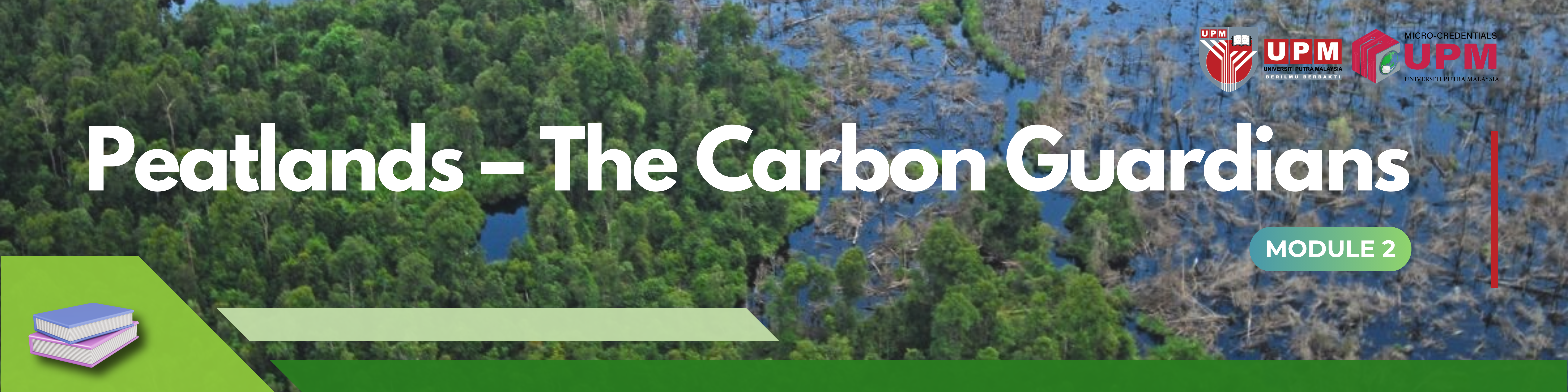
      Synopsis: Peatlands- The Carbon Guardians

      This module introduces participants to the characteristics and ecological importance of peatland ecosystems, one of Malaysia’s most significant natural carbon stores. Participants will explore peatland formation, hydrological processes, and ecosystem functions, including their roles in carbon storage, biodiversity conservation, climate regulation, and ecosystem resilience.

      The module also examines the importance of maintaining healthy peatland ecosystems through sustainable management and conservation practices. Participants will be introduced to key strategies such as rewetting, fire prevention, and responsible land-use management aimed at protecting peatland integrity and reducing carbon emissions. By the end of the module, participants will be able to explain the characteristics and carbon storage functions of peatlands, describe the role of hydrology in peat ecosystems, and discuss basic approaches to peatland conservation and sustainable management.

    • LEARNING OUTCOME (LO)

      1. Explain peatland characteristics, carbon storage functions, and the role of hydrology in peat ecosystems.
      2. Describe key management strategies for peatland conservation, including rewetting and fire prevention

      1.    

      • MASUKKAN VIDEO PENGENALAN MODULE NI.

      LET'S DIVE INTO PEATLANDS!

    • Please refer to and review the lecture notes given to dive into the peat swamp forest. You will learn about the unique characteristics of the peat swamp forest and understand why it is important.

    • WATCH THIS VIDEO TO HELP YOU UNDERSTAND THE PEATLANDS ECOSYSTEM. 

    • CONGRATULATIONS

      Congratulations on successfully completing this course. We hope that you have gained a solid understanding of the following:

      1. Classify major forest stand types in Malaysia. (C2)
      2. Explain the functions and importance of forest ecosystems. (C2)
      3. Describe sustainable forest management practices. (C2)

      Please check your dashboard to view your digital badge and certificate (if available). The certificate will be awarded only if you have completed all the links and activities in this module.

      For any enquiries, please contact the course instructor at norizah_k@upm.edu.my

    • Acknowledgements

      We would like to express our sincere appreciation and gratitude to:

      • Faculty of Forestry and Environment, Universiti Putra Malaysia (UPM)
        For its expertise, guidance, and contributions in developing high-quality learning materials that support sustainable tropical forest management and environmental conservation.
      • Universiti Putra Malaysia (UPM)
        For its support in the development and implementation of this micro-credential course, as well as its continuous commitment to advancing skills-based education and lifelong learning.
      • Micro-Credential Course Participants
        For your active participation, enthusiasm, and commitment to enhancing your knowledge and understanding of sustainable forest management and forest ecosystem conservation.

      Thank you for your support and contribution to the success of this course. 🌳🌿

    • Names of Development Team Members:

      Assoc Prof Gs Dr Norizah Kamarudin

      Dr Jamhuri Jamaluddin

      Dr Diana Emang

      • senaraikan rujukan