Text size
Line height
Text spacing
WELCOME AND GREETINGS!
We are delighted to have you join us as we explore the fundamental concepts and practical skills needed to develop effective questionnaires for research and data collection.
Throughout this course, you will gain a deeper understanding of how questionnaires are used, learn to identify different types of measurement scales, and apply essential principles to design clear, reliable, and meaningful survey instruments. Whether you are new to research or looking to strengthen your existing skills, this course is designed to provide you with valuable insights and hands-on knowledge. Participants are expected to complete all learning activities and assessments in each module. Upon successful completion, participants will receive digital badges for each module and be awarded the Micro-Credential Certificate in Questionnaire Development.
We encourage you to actively participate, share your ideas, and engage in discussions to make the most of your learning experience. Let’s get started and make this a productive and enjoyable journey together!
Synopsis
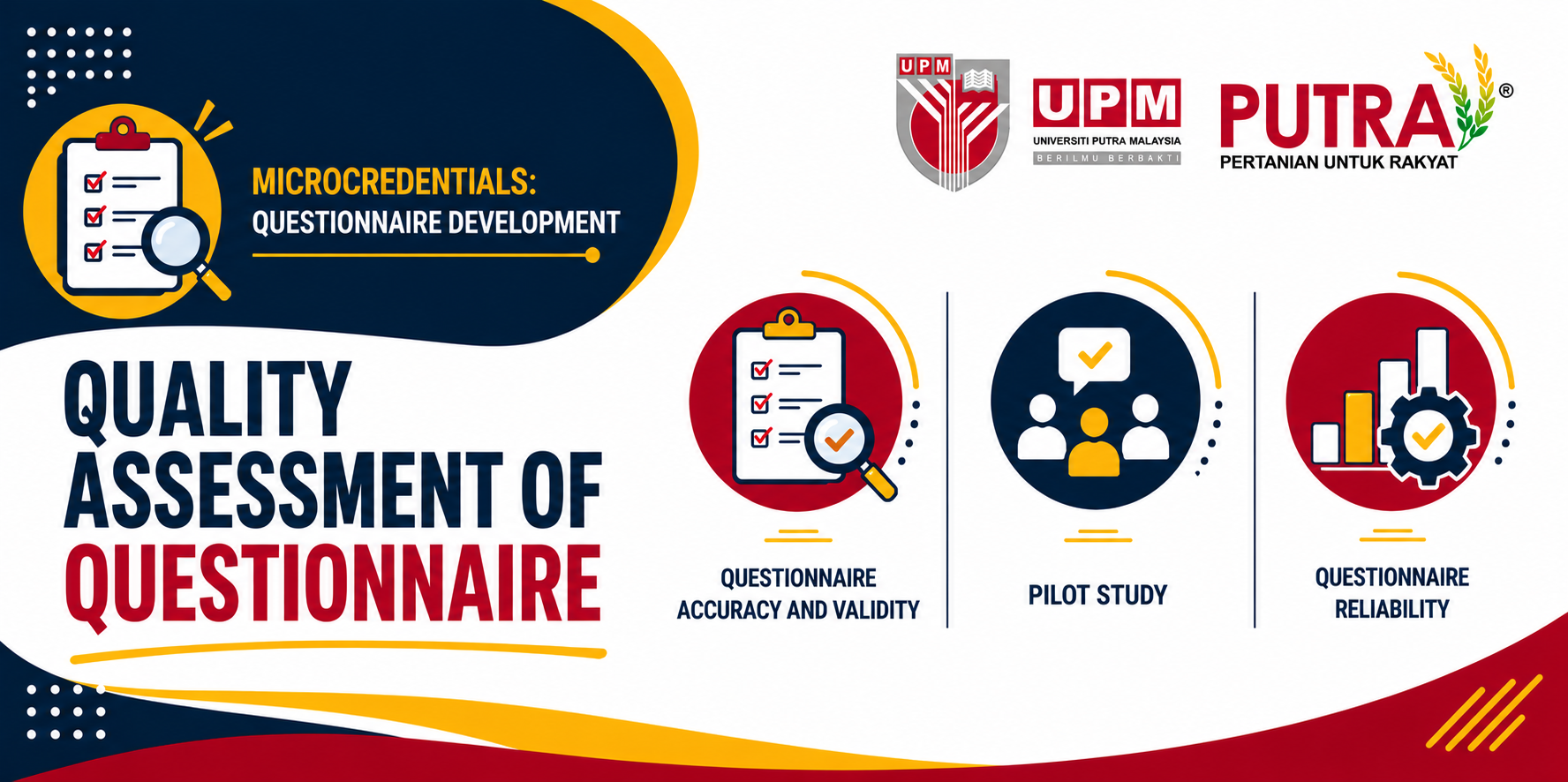
Participants will develop a clear understanding of the principles of questionnaire quality assessment, focusing on how accuracy, validity, and reliability underpin effective data collection. They will be able to critically evaluate the extent to which a questionnaire measures what it is intended to measure (validity), produces consistent results across time and contexts (reliability), and ensures accuracy in capturing respondents’ perspectives. Participants will also explore the importance of pilot studies and pre-testing as essential steps in identifying weaknesses, refining questions, and improving overall instrument quality. By applying these principles, participants will gain the ability to design and assess questionnaires that generate trustworthy, meaningful, and actionable results across diverse research settings.
Learning outcomes
At the end of this course, participants will be able to: