1. Chapter 1: A Review : Distributed System
1.7. Example of the Web
- HyperText Markup Language
A language for specifying the contents and layout of pages
- Uniform Resource Locators
Identify documents and other resources
- A client-server architecture with HTTP
By with browsers and other clients fetch documents and other resources from web servers
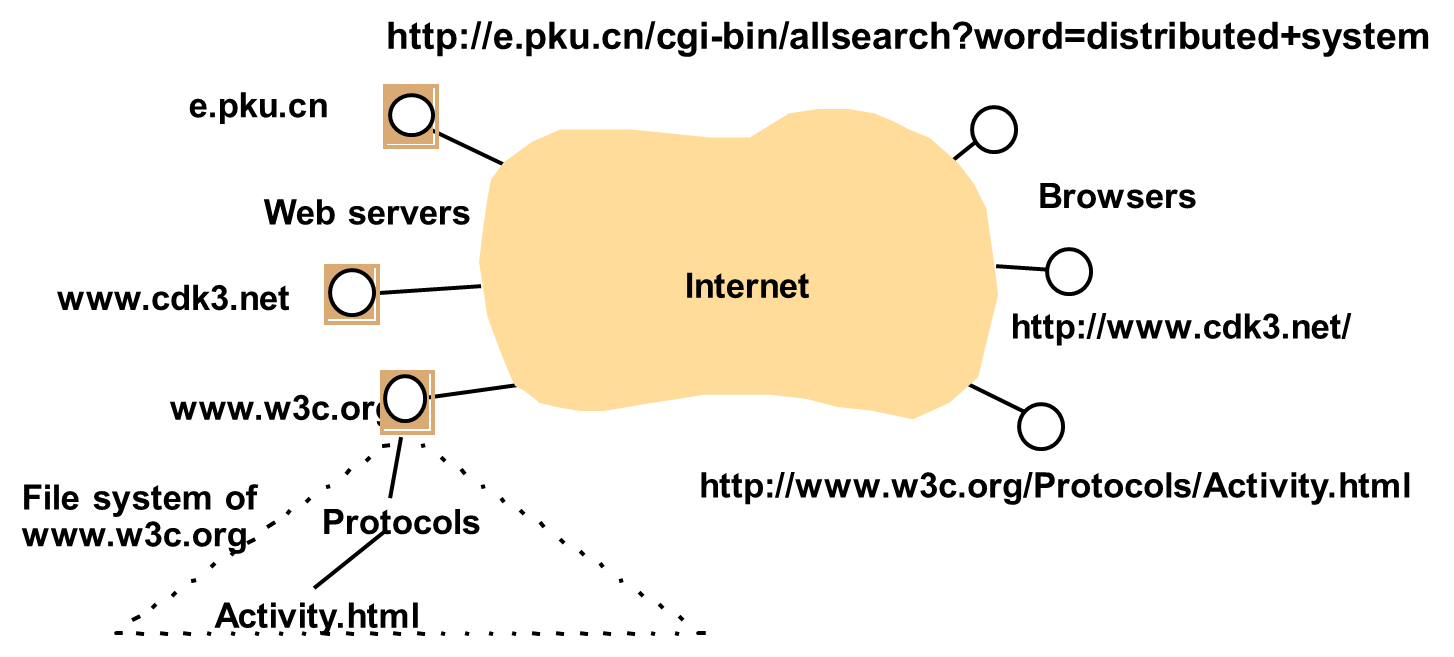
Example of the Web : html
- HTML text is stored in a file of a web server.
- A browser retrieves the contents of this file from a web server.
- To identify which web server maintains the resource
- To identify which of the resources at that server
Example of the
Web : URL
- Scheme: scheme-specific-location
| Server
DNS name | Pathname
on server | Arguments |
|---|
| www.cdk3.net | (default) | (none) |
| www.w3c.org | Protocols/Activity.html | (none) |
| e.pku.cn | cgi-bin/allsearch | word=distributed+system |
- Publish a resource remains unwieldy
Example of the
Web : HTTP
- Defines the ways in which browsers and any other types of client interact with web servers (RFC2616)
- Main features
- Request-replay interaction
- Content
types. The strings that denote the type of
content are called MIME (RFC2045,2046)
- One resource per request. HTTP version 1.0
- Simple access control
- Dynamic content
- Common Gateway Interface: a program that web servers run to generate content for their clients
- Student : Downloaded code JavaScript or Applet that shows web functions and services.
Discussion of Web
- Dangling: a resource is deleted or moved, but
links to it may still
remain
- Find
information easily: e.g.
Resource Description Framework which standardize the format of metadata about web resources
- Exchange
information easily: e.g. XML
– a self describing language
- Scalability: heavy load on popular web servers
- More
applets or many images in pages increase in the download
time


