8. Chapter 8: Replication
8.1. System model and the role of group communication
System model
- Data in the system consist of a collection of items called objects.
- An ‘object’ could be a file (example: Java object).
- Each such logical object is implemented by a collection of physical copies called replicas.
- Replicas are physical objects, each stored at a single computer, with data and behaviour that are tied to some degree of consistency by the system’s operation.
- The ‘replicas’ of a given object are not necessarily identical, at least not at any particular point in time.
- Some replicas may have received updates that others have not received.
- Assume that an asynchronous system in which processes may fail only by crashing.
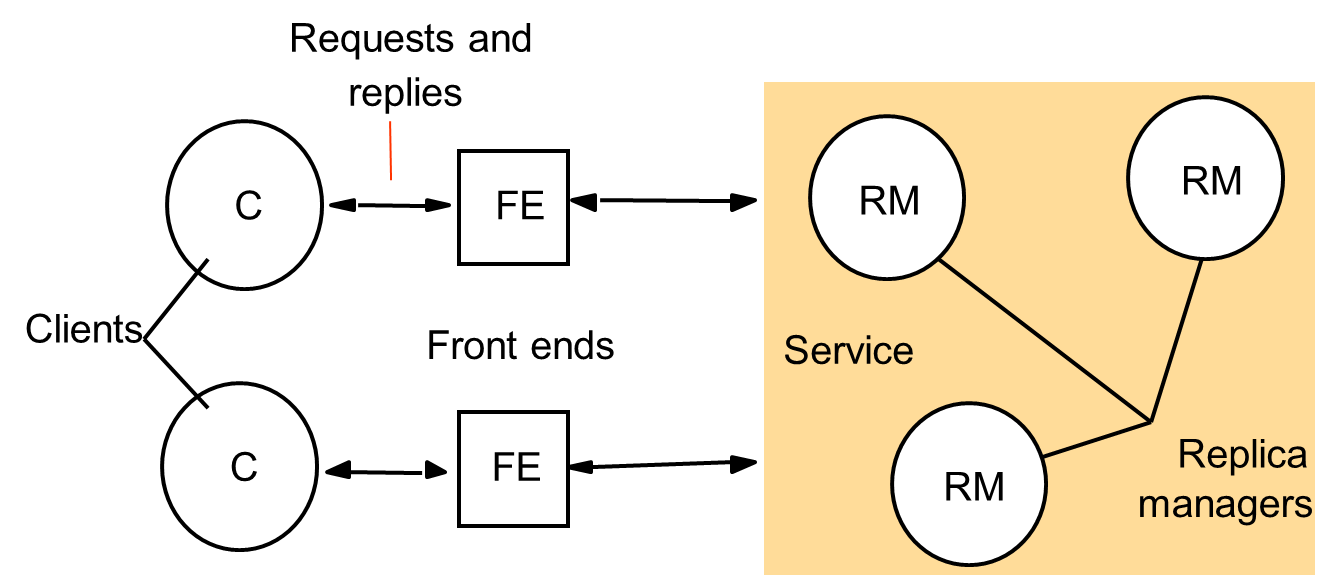
- Involves replicas held by distinct replica managers – components that contain the replicas on a given computer and perform operations upon them directly.
- Replica manager applies operations to its replicas recoverably.
- An operation at a replica manager does not leave inconsistent result if it fails part way through.
- A replica manager applies operations to its replicas atomically.
- The state of the replicas is a deterministic function of their initial states and the sequence of operations that it applies to them.
- The set of replica managers may be static or dynamic.
- In a dynamic system
- New replica managers may appear.
- Replica managers may crash, then they are then deemed to have left the system (may be replaced).
- In a static system
- Replica managers do not crash.
- But they may cease operating for an indefinite period.
- A collection of replica managers provides a service to clients.
- Each client’s request are first handled by a component called a front end.
- Front end:
Five phases are involved in the performance of a single request upon the replicated objects
- Requests:
- The front end issues the request to one or more replica managers.
- Coordination:
- The replica managers coordinate in preparation for executing the request consistently.
- They decide on the ordering of this request relative to others.
- Execution
- The replica managers execute the request – perhaps tentatively: they can undo its effect later.
- Agreement
- The replica managers reach consensus on the effect of the request – if any – that will be committed.
- Response
- One or more replica managers responds to the front end.
- The front end pass back the response to the client.
The role of group communication
- Requirement for dynamic membership where processes join and leave the group as the system executes.
- Users may add or withdraw a replica manager, or a replica manager may crash and thus need to be withdrawn from the system’s operation.
- Fault-tolerant system – systems that can adapt as processes join, leave and crash – require more advanced features in failure detection and notification of membership changes.
- Group views
- List of the current group members, identified by their unique process identifiers.
- The list is ordered
- Example: according to the sequence in which the members joined the group.
- New group view is generated each time that a process is added or excluded.
- Process is suspended
- Group membership service exclude it.
- The process is not crashed.
- Might be communication failure -> process unreachable but it continues to execute normally.
- Effect of exclusion:
- No messages will be delivered to that process
- If that process becomes connected again, any messages it attempts to send will not be delivered to the group members.
- The process have to re-join the group (obtain new identifier), or abort its operation.
- However, false suspicion may reduce the group’s effectiveness.
- Design challenge
- Ensure that a system based on group communication does not behave incorrectly if a process is falsely suspected.
For network partitions, group management differ in whether they are primary-partition or partitionable.
Primary-partition
- The management service allows at most one subgroup (a majority) to survive a partition
- The remaining processes are informed that they should suspend operations.
- Appropriate in the case where the processes manage important data and the costs of inconsistencies between two or more subgroups is high.
Partitionable
- Acceptable for two or more subgroups to continue to operate
- Example:
- An application in which users hold an audio or video conference to discuss some issues.
- Maybe acceptable for two or more subgroups of users to continue their discussion independently despite a partition.
- They can merge their results when the partition heals and the subgroups are connected again.
View delivery
- For each group g the group management service delivers to any member process p g a series of views vo(g), v1(g), v2(g), etc.
- For example: a series of views could be vo(g) = (p), v1(g) = (p, p’) and v2(g) = (p) – p joins an empty group, then p’ joins the group, then p’ leaves it.
- Although several membership changes may occur concurrently, the system imposes an order on the sequence of views given to each process.
- Basic requirement for view delivery
- Order: if a process p delivers view v(g) and then view v’(g), then no other process q ≠ p delivers v’(g) before v(g).
- Integrity: if process p delivers view v(g), then p \( \in \) v(g).
- Non-triviality: If process q joins a group and is or becomes indefinitely reachable from process p ≠ q, then eventually q is always in the views that p delivers. Similarly, if the group partitions and remains partitioned, then eventually the views delivered in any one partition will exclude any processes in another partition.
View-synchronous group communication
- For simplicity, assume partitions may not occur.
- Makes guarantees additional to those above about the delivery ordering of view notifications with respect to the delivery of multicast messages.
- The guarantees: