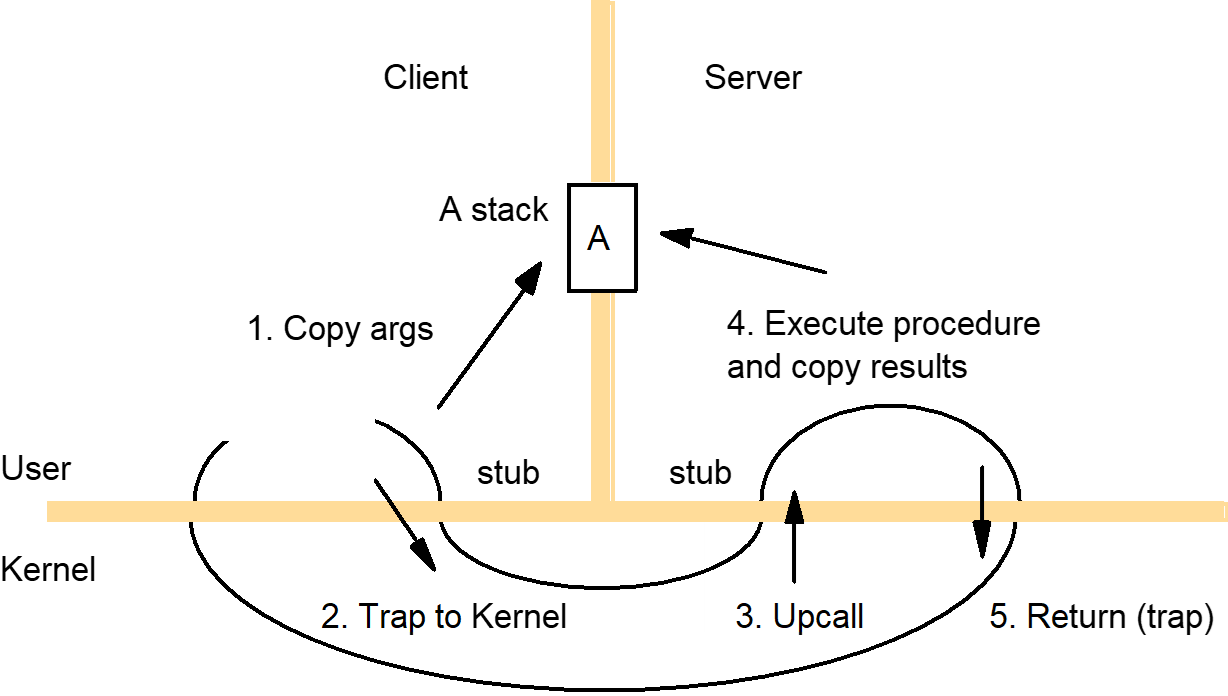
iii.
Packet initialization
–Involves initializing protocol headers
and trailers, including checksums.
iv.
Thread scheduling and context switching
–Several system calls are made during an
RPC, as stubs invoke the kernel’s communication operations
–One or more server threads is scheduled.
–If the operating system employs a
separate network manager process, then each Send involves a context switch to
one of its threads.
v.
Waiting for acknowledgements:
–The choice of RPC protocol may influence
delay, particularly when large amounts of data are sent.
iii.
Packet initialization
–Involves initializing protocol headers
and trailers, including checksums.
iv.
Thread scheduling and context switching
–Several system calls are made during an
RPC, as stubs invoke the kernel’s communication operations
–One or more server threads is scheduled.
–If the operating system employs a
separate network manager process, then each Send involves a context switch to
one of its threads.
v.
Waiting for acknowledgements:
–The choice of RPC protocol may influence
delay, particularly when large amounts of data are sent.
Communication primitives
- Some kernels designed for distributed systems have provided communication primitives tailored to the types of invocation.
- Example:
- Amoeba provides doOperation, getRequest and sendReply as primitives.
- Amoeba, the V system and Chorus provide group communication primitives.
- Middleware provides RMI over UNIX’s connected (TCP) sockets, then a client must make two communication system calls (socket write and read) for each remote invocation.
- Over Amoeba, it require only a single call to doOperation.
- Despite the widespread use of TCP and UDP sockets provided by common kernels, research continues to be carried out into lower-cost communication primitives in experimental kernels.
Protocols and openness
- One of the main requirements of the operating system is to provide standard protocols that enable internetworking between middleware implementations on different platforms.
- By contrast, the designers of the Mach 3.0 and Chorus kernels (as well as L4) decided to leave the choice of networking protocols entirely open.
- These kernels provide message passing between local processes only, and leave network protocol processing to a server that runs on top of the kernel.
- Protocols are normally arranged in a stack of layers.
- Many operating systems allow new layers to be integrated statically.
- By contrast, dynamic protocol composition is a technique whereby a protocol stack can be composed on the fly to meet the requirements of a particular application, and to utilize whichever physical layers are available given the platform’s current connectivity.
- Example: a web browser running on a notebook computer should be able to take advantage of a wide area wireless link while the user is on the road, and then a faster Ethernet connection when the user is back in the office.
- Support for protocol composition appeared in the design of the UNIX Streams facility [Ritchie 1984], in Horus [van Renesse et al. 1995] and in the x-kernel [Hutchinson and Peterson 1991], construction of configurable transport protocol CTP on top of the Cactus system [Bridges et al. 2007].
Invocation performance
- Invocation performance is a critical factor in distributed system design.
- The more designers separate functionality between address spaces, the more remote invocations are required.
- Invocation costs
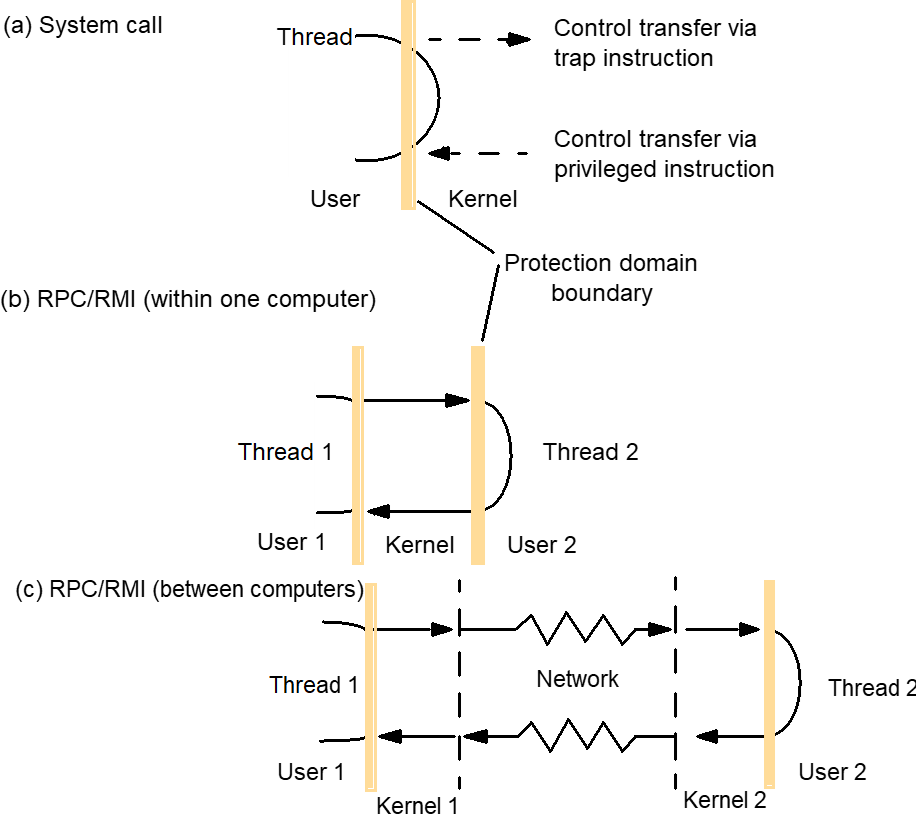
- Calling a conventional procedure or invoking a conventional method, making a system call, sending a message, remote procedure calling and remote method invocation are all examples of invocation mechanisms.
- Each mechanism causes code to be executed outside the scope of the calling procedure or object.
- Each involves, in general, the communication of arguments to this code and the return of data values to the caller.
Figure : Invocations between address spaces
- Invocation over the network
- A null RPC (and similarly, a null RMI) is defined as an RPC without parameters that executes a null procedure and returns no values.
- Its execution involves an exchange of messages carrying some system data but no user data.
- Much of the observed RPC delay is accounted by the actions of the operating system kernel and user-level RPC runtime code and not from the total network transfer time.
- Null invocation costs are important because they measure a fixed overhead, the latency.
Figure : RPC delay against parameter size

- RPC throughput is also a concern when data has to be transferred in bulk.
- Steps in an RPC
- A client stub marshals the call arguments into a message, sends the request message and receives and unmarshals the reply.
- At the server, the worker thread calls the appropriate server stub.
- The server stub unmarshals the request message, calls the designated procedure and marshals and send the reply.
- Main components accounting for remote invocation delay, beside network transmission times:
- Marshalling → Marshalling and unmarshaling, which involve copying and converting data, create a significant overhead as the amount of data grows.
- Data copying
- Even after marshalling, message data is copied several times:
- Across the user-kernel boundary, between the client or server address space and kernel buffers;
- Across each protocol layer
- Between the network interface and kernel buffers
- Transfer between network interface and main memory are usually handled by direct memory access (DMA).
- Packet initialization
- Involves initializing protocol headers and trailers, including checksums.
- Thread scheduling and context switching
- Several system calls are made during an RPC, as stubs invoke the kernel’s communication operations
- One or more server threads is scheduled.
- If the operating system employs a separate network manager process, then each Send involves a context switch to one of its threads.
- Waiting for acknowledgements:
- The choice of RPC protocol may influence delay, particularly when large amounts of data are sent.