7. Chapter 7: Transaction and Concurrency Control
7.6. Locks
Two-phase locking
- Transaction is not allowed any new locks after it has released a lock.
- The first phase of each transaction is a ‘growing phase’, during which new locks are acquired.
- In the second phase, the locks are released (a ‘shrinking phase’).
Strict two-phase locking
- Any locks applied during the progress of a transaction are held until the transaction commits or aborts.
- When a transaction commits, to ensure recoverability, the locks must be held until all the objects it updated have been written to permanent storage.
Concurrency control protocols are designed to cope with conflicts between operations in different transactions on the same object.
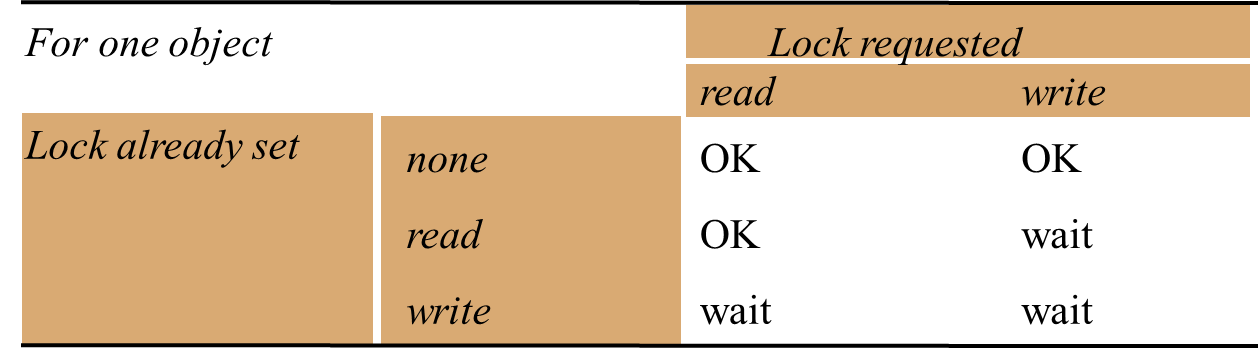
Two types of locks are used: read locks and write locks.
All the transactions reading the same object share its read lock – read locks are sometimes called shared locks.
Figure
14: Transactions T and U with exclusive locks
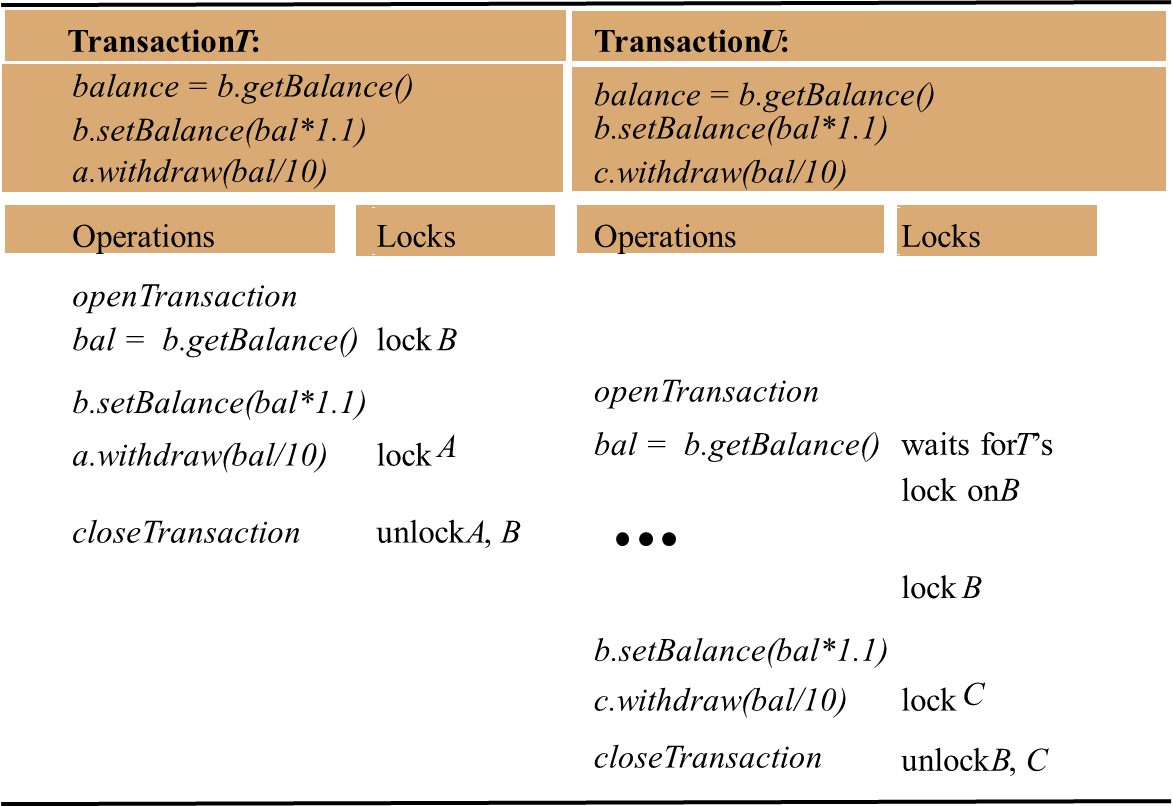
Operation conflict rules
- If a transaction T has already performed a read operation on a particular object, then a concurrent transaction U must not write that object until T commits or aborts.
- If a transaction T has already performed a write operation on a particular object, then a concurrent transaction U must not read or write that object until T commits or aborts.
For the first condition: a request for a write lock on an object is delayed by the presence of a read lock belonging to another transaction.
For the second condition: a request for either a read lock or a write lock on an object is delayed by the presence of a write lock belonging to another transaction.
Inconsistent retrievals:
Lost updates

Increasing concurrency in locking schemes
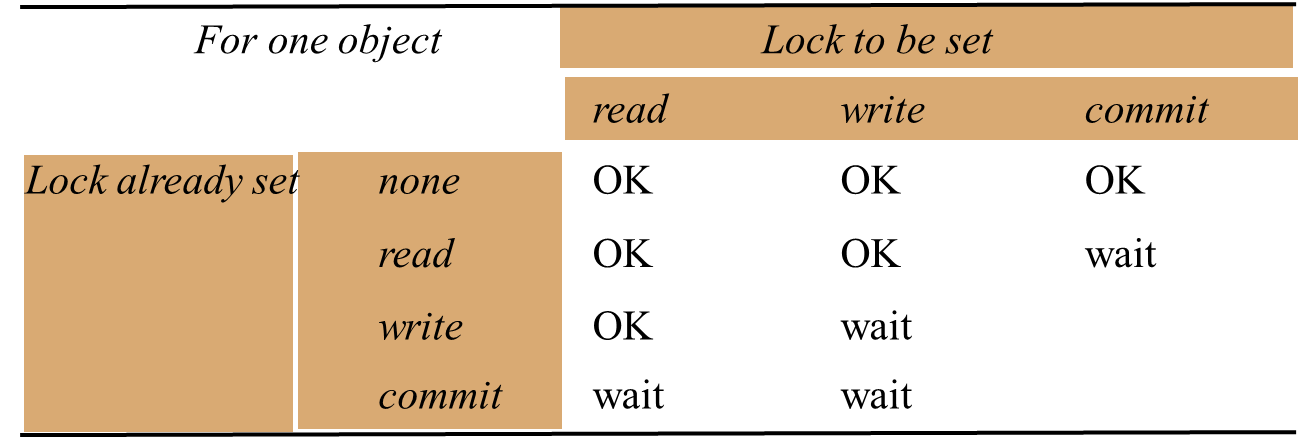
- Two-version locking
- Allows one transaction to write tentative versions of objects while other transactions read from the committed versions of the same objects.
- Read operations only wait if another transaction is currently committing the same object.
- Transactions cannot commit their write operations immediately if other uncompleted transactions have read the same objects.
- Must wait until the reading transactions have completed.
- Deadlocks may occur
- Transactions are waiting to commit
- May need to abort some transactions when they are waiting to commit to resolve deadlocks.
- 3 types of locks: read lock, write lock and commit lock.
Figure
25: Lock hierarchy for the banking example

Figure
26: Lock hierarchy for a diary